
Google’s 100-Hour ($1 Billion) Battery to Power New Data Centre
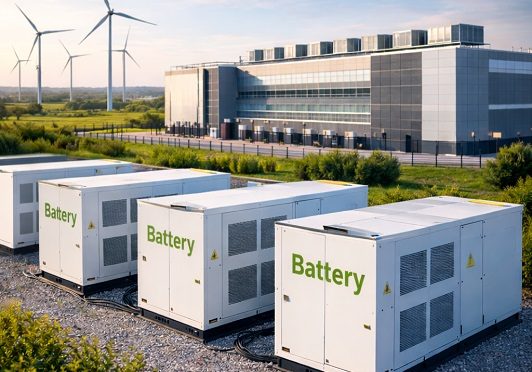
Google has announced plans to build a new data centre in Pine Island, Minnesota, powered by wind, solar and a 300-megawatt, 100-hour iron-air battery supplied by US startup Form Energy, marking a significant test of long-duration energy storage at hyperscale.
Minnesota and the Clean Energy Structure
The project, revealed in February, will be developed in partnership with Minnesota-based (headquartered in Minneapolis) electric and gas utility Xcel Energy and introduces a new contract mechanism called the Clean Energy Accelerator Charge (CEAC). Under the arrangement, Google will cover all costs associated with its electric service, with the aim of accelerating clean energy deployment without shifting costs onto other customers.
As part of the agreement, 1,400 megawatts of new wind generation and 200 megawatts of solar will be added to Xcel’s grid to support the data centre, alongside the 300 MW iron-air battery system already announced. The combination is intended to provide a more balanced solution, pairing large-scale renewable capacity with multi-day storage. Google says it will also contribute $50 million to bolster Xcel’s Capacity*Connect programme, which is designed to deploy up to 200 MW of distributed battery storage across Minnesota by 2028 to strengthen grid resilience.
Google describes the partnership as an opportunity to “reimagine how data centres can be served”, positioning the project as a catalyst for electricity innovation rather than a conventional power purchase arrangement.
The New Battery
At the centre of the announcement is Form Energy’s iron-air battery, capable of delivering 300 MW continuously for up to 100 hours. Unlike lithium-ion systems, which typically discharge over four to six hours, iron-air technology is designed for multi-day storage. It works by using oxygen to rust iron, releasing electrons during discharge and reversing the process during charging.
According to one source (The Information), Google’s agreement with Form Energy could be valued at around $1 billion, making it one of the most significant commercial deployments of long-duration energy storage to date.
For data centres increasingly driven by AI workloads, energy reliability is becoming as important as raw capacity. Wind and solar can provide large volumes of low-carbon electricity, but their intermittency presents operational challenges. A 100-hour battery is intended to smooth fluctuations over multiple days rather than just peak hours.
Scaling AI Without Straining the Grid
The timing is significant. Hyperscale data centre demand in the United States has surged, particularly in regions with strong renewable resources. At the same time, utilities and regulators face mounting pressure to ensure that new data centre loads do not drive up energy prices or compromise grid reliability.
In Texas, where Google has also announced new facilities, the company has highlighted a “power first” co-location model and air-cooling systems designed to limit operational water use to “only critical campus operations like kitchens.” Across the state, Google says it has contracted more than 7,800 MW of net-new energy generation and capacity through power purchase agreements.
Minnesota’s model is different because it combines large-scale renewables with long-duration storage and distributed battery networks. For Xcel Energy, which has plans to install 600 MW of energy storage by 2030, the Google partnership provides both capital and a high-profile validation of distributed capacity strategies.
Commercial and Technical Realities
While the announcement shows real ambition, several practical questions remain. Iron-air technology has been demonstrated at pilot scale, but Minnesota represents one of its first major commercial deployments. Manufacturing scale-up, cost discipline and long-term performance under real grid conditions will be closely watched.
Also, although the 100-hour battery is designed to address the challenge of multi-day variability in wind and solar output, it does not remove the need for transmission upgrades, dispatchable generation or demand management.
For Google, the commercial logic also extends beyond sustainability credentials. Securing predictable, long-term clean energy supply can reduce exposure to volatile wholesale markets and regulatory scrutiny. It also strengthens the company’s narrative that AI growth can align with decarbonisation goals rather than undermine them.
For Form Energy, the agreement provides a landmark customer and potential springboard towards a planned public listing. The company has reportedly raised over $1.4 billion to date and is building manufacturing capacity in West Virginia.
What Does This Mean For Your Business?
For most UK businesses, a 300 MW, 100-hour battery may feel like something that is still some way off in the future. However, energy resilience is steadily becoming a board-level issue rather than simply an operational one. As organisations expand their digital infrastructure, the questions are shifting from how much energy is consumed to how securely and predictably it can be supplied. Reliability, price stability and long-term sustainability are increasingly linked.
Long-duration storage is one potential response to that challenge. Buying renewable power helps reduce carbon intensity. Ensuring supply remains stable during prolonged periods of low wind or solar output supports operational continuity. For businesses with growing digital demands, the difference between those two objectives is becoming increasingly important.
The way the deal has been structured is also worth noting. Google has linked its expansion to additional clean capacity in a way that is intended to avoid shifting costs onto other customers. Most SMEs will never negotiate at this scale, but the underlying principle of matching growth with demonstrable energy impact is increasingly shaping procurement decisions, sustainability reporting and investor scrutiny.
At the same time, public attention on data centre energy and water use is increasing. Businesses expanding cloud and AI capabilities should expect greater transparency requirements around sourcing, efficiency and grid effects. Sustainability claims will increasingly need to be backed by operational evidence.
Minnesota will now act as a practical test. If multi-day storage performs reliably at this scale, it could strengthen the case for deeper renewable integration across energy-intensive industries. If it struggles, it will reinforce how complex the transition remains. Either way, projects like this may be shaping the framework within which future digital growth will need to operate.